
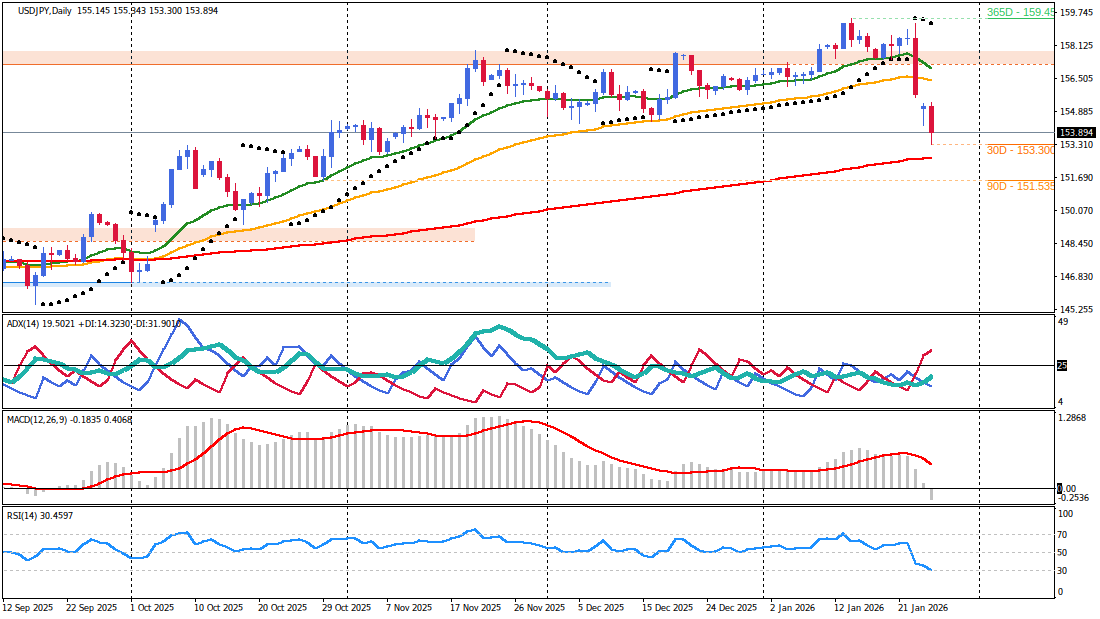
The USD/JPY currency pair is currently navigating a period of intense selling pressure, trading near its lowest levels since November 2025. Technical structure combined with rumors of coordinated FX intervention between the Japanese authorities and the US Treasury supports a decisive bearish bias in the medium term. Price action has breached a long-term ascending channel, signaling a fundamental shift in market regime as traders aggressively unwind long-dollar positions. While the pair is entrenched in a downtrend, extreme oversold readings on the H4 timeframe suggest a temporary exhaustion of momentum, leading to a consolidation phase ahead of the Federal Open Market Committee (FOMC) decision. Critical structural support at the 152.61 level remains the primary objective for bears, while the fundamental narrative is dominated by the Bank of Japan’s (BoJ) upward revision of inflation and the US Federal Reserve's upcoming policy guidance.
Technical Analysis
Multi-Timeframe Market Structure
The dominant structure on the Daily (D1) timeframe has shifted decisively bearish as price action trades significantly below both the EMA20 and EMA50. This breakdown reflects a broader deterioration in sentiment, with the Relative Strength Index (RSI) hovering near 30. While the primary trend is down, the long-term EMA200 at 152.61 serves as the ultimate structural floor and the final line of defense for the multi-year bullish trend. Technical structure combined with the recent break of the ascending channel suggests that any rallies will likely be met with fresh supply.
On the H4 timeframe, momentum is exceptionally bearish, evidenced by an Average Directional Index (ADX) reading of 47.43. However, the RSI at 23.12 and Stochastic at 12.18 are in deep oversold territory, which typically precedes a mean reversion toward the H4 EMA20 near 155.99. This technical extension aligns with the fundamental backdrop of market participants pausing to digest recent intervention rumors.
Critical Price Levels & Momentum Assessment
The pair is currently engaged in a tentative bottoming process near the 153.71 intraday low. Price action aligns with the fundamental uncertainty surrounding the FOMC to favor a period of horizontal consolidation. Immediate resistance is found at 154.56, representing the confluence of the M30 EMA50 and the recent H1 breakdown point. A failure to clear this zone confirms that current recovery attempts are merely corrective within a larger bearish framework.
- Resistance Levels:
- 154.56: Immediate intraday hurdle and M30 EMA50.
- 155.53: H1 EMA50 and structural pivot from previous sessions.
- 156.00: Psychological level and H4 EMA20.
- Support Levels:
- 153.71: Primary intraday support and recent low.
- 153.00: Psychological round number.
- 152.61: Critical D1 EMA200; the long-term structural floor.
Fundamental Market Drivers
Central Bank Policy & Economic Outlook
The fundamental landscape for USD/JPY is currently defined by the diverging paths of the Bank of Japan and the Federal Reserve. The BoJ recently left its policy rate unchanged but significantly revised its inflation outlook upward, a move that provided the initial catalyst for Yen strength. Governor Kazuo Ueda’s post-meeting press conference triggered volatile trading, but the underlying hawkish tilt in inflation expectations continues to support the Yen. This aligns with technical signals showing a shift in medium-term trend direction.
Conversely, the Federal Reserve is widely expected to hold the Federal Funds Rate at the 3.75%–3.75% range during tomorrow's meeting. However, the focus remains on Chair Jerome Powell’s forward guidance. Markets are currently pricing in approximately 44 basis points of easing toward the end of the year. Any dovish shift in Powell's rhetoric would likely accelerate the technical breakdown toward the 152.61 support level. Technical structure combined with the potential for Fed independence concerns under the current US administration reinforces the downward pressure on the Greenback.
Market Sentiment & Risk Environment
Risk sentiment is heavily influenced by intense speculation regarding a joint currency intervention. Reports that the New York Fed conducted "rate checks" on behalf of the US Treasury have fueled fears of coordinated action to stabilize the Yen, an event not seen in 15 years. This fundamental catalyst has driven a 600-pip decline since Friday. Japanese officials, including Finance Minister Satsuki Katayama and Chief Cabinet Secretary Seiji Kihara, have reinforced this sentiment by expressing a "high sense of urgency" regarding one-sided currency moves.
Furthermore, political uncertainty in Japan adds a layer of complexity. Prime Minister Sanae Takaichi’s decision to call a snap election and her plans for fiscal expansion have raised concerns over Japan’s public debt burden. However, the "intervention fear" currently outweighs fiscal concerns, keeping the Yen firm. In the US, President Trump’s trade rhetoric and threats of tariffs on Canada and France have introduced a risk-off environment that favors safe-haven Yen buying over the US Dollar, aligning with the bearish technical structure.
Integrated Trading Execution
Primary Trading Scenario
- Bias: Bearish continuation following a corrective recovery.
- Trigger/Entry: Short entries in the 154.50 to 154.60 zone upon bearish confirmation on lower timeframes. This zone aligns with the M30 EMA50 and H1 resistance cluster.
- Stop-Loss: 155.10 - Positioned above the H1 EMA50 to protect against volatility spikes.
- Profit Targets:
- Target 1: 153.75 - Immediate retest of the current intraday support floor.
- Target 2: 153.10 - Extension toward the psychological 153.00 handle ahead of the D1 EMA200.
- Session Context: High-probability execution during the London/New York overlap when liquidity peaks and US data releases provide volatility.
Alternative Market Scenario
- Invalidation: A sustained H1 candle close above 154.70, suggesting a short-squeeze and deeper corrective move.
- Bias: Bullish corrective bounce (mean reversion).
- Trigger/Entry: Breakout above 154.70 with strong momentum.
- Stop-Loss: 154.10 - Below the intraday pivot.
- Profit Targets:
- Target 1: 155.50 - Retest of the bearish gap area and H1 EMA50.
- Target 2: 156.00 - Psychological resistance and H4 EMA20.
- Session Context: Likely to occur if US CB Consumer Confidence data significantly exceeds expectations or if intervention fears temporarily subside.
Risk Management & Catalyst Analysis
Trade Risk Assessment
The trade carries a medium confidence level due to the extreme oversold conditions on H4 oscillators. There is a significant risk of a "mean reversion" rally if profit-taking accelerates ahead of the FOMC. Traders should account for the potential of sharp spikes during the Asian/London transition, where liquidity can be thin. Price action aligns with fundamental intervention risks, suggesting that stop-losses must be strictly adhered to, ideally maintained at a 1.25x ATR buffer (approximately 50 pips) to avoid being hunted by market noise near the 154.50 resistance zone. Reducing position size by 50% is recommended given the high-impact nature of the upcoming Federal Reserve decision.
Economic Calendar & Event Impact
- US CB Consumer Confidence (Today, 15:00 UTC): Forecast 90.6, Previous 89.1 - Higher than expected data could trigger the alternative bullish corrective scenario.
- US President Trump Speaks (Today, 19:00 UTC): No Forecast - Comments on trade or Fed independence will drive substantial volatility in the USD.
- US Federal Funds Rate & FOMC Statement (Tomorrow, 19:00 UTC): Forecast 3.75%, Previous 3.75% - The primary catalyst for the week; hawkish or dovish shifts will determine the sustainability of the current downtrend.
- JN Tokyo Core CPI y/y (January 29, 23:30 UTC): Forecast 2.2%, Previous 2.3% - Critical for validating the BoJ's recent upward inflation revisions.
- US Core PPI m/m (January 30, 13:30 UTC): Forecast 0.3%, Previous 0.0% - Final inflation check for the week, impacting US Treasury yields and USD demand.
Synthesized Market Outlook
The outlook for USD/JPY remains fundamentally and technically bearish as the market prices in the increased probability of joint intervention and a potential dovish pivot from the Federal Reserve. The technical breakdown below the long-term ascending channel marks a significant shift in market character, moving from a "buy-the-dip" regime to a "sell-the-rally" environment. The aggressive nature of the recent sell-off suggests that institutional participants are repositioning for a lower USD/JPY exchange rate in the first quarter of 2026.
Traders should monitor the 154.50–154.70 resistance zone closely; as long as price remains below this area, the path of least resistance is toward the 152.61 structural floor. A breach of 152.61 would argue for a full reversal of the 2025 uptrend, potentially targeting the 150.00 psychological handle. Conversely, the high-impact FOMC event on Wednesday remains the ultimate arbiter of trend direction, and any signals of Fed resilience could delay the bearish extension. Monitoring both technical levels and verbal intervention warnings from Tokyo remains paramount for navigating this high-volatility environment.


