
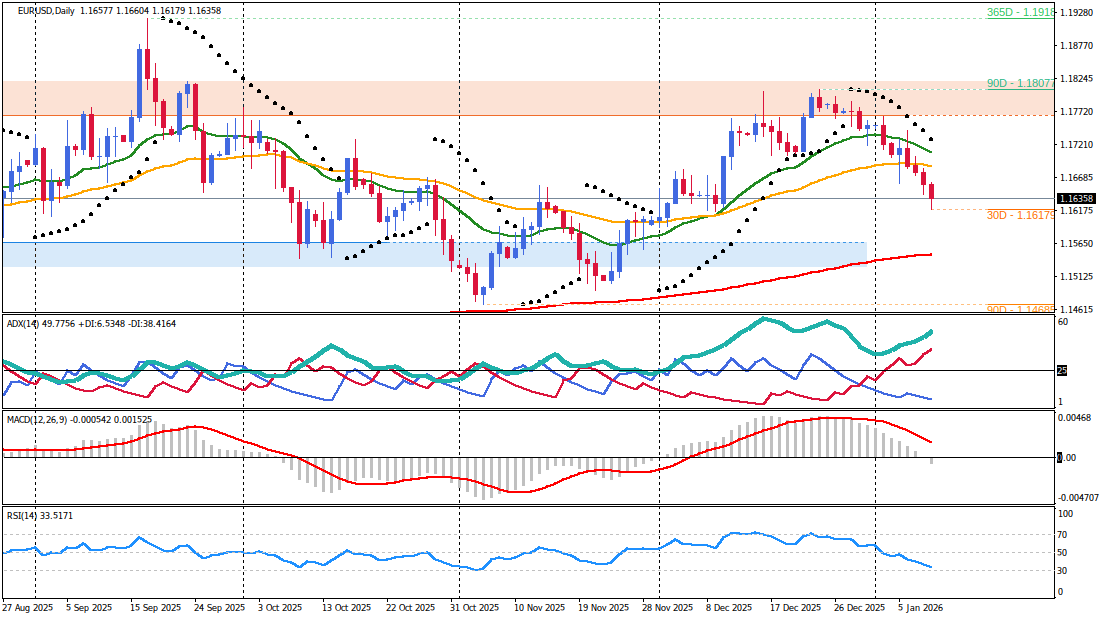
The EUR/USD pair is entrenched in a dominant bearish technical structure across all timeframes, with price trading decisively below key moving averages and momentum indicators deeply oversold. Fundamentally, this technical pressure is amplified by sustained US dollar strength, driven by resilient economic data and fading market expectations for imminent Federal Reserve rate cuts. Positive Eurozone data releases have been largely ignored by traders, as the European Central Bank's neutral stance offers no counterweight to dollar demand. The confluence of these factors sets the stage for further declines, with critical high-impact US inflation data (CPI and PPI) scheduled for January 13-14 poised to dictate near-term volatility and potentially validate the downtrend. The integrated market view favors selling into strength, with a break below 1.1590 support as the next likely technical objective unless fundamental catalysts trigger a reversal.
Technical Analysis
Multi-Timeframe Market Structure
The daily chart confirms a powerful downtrend with price entrenched below the EMA20, EMA50, and EMA200, establishing a clear pattern of lower highs and lower lows. The RSI at 33.52 and a negative MACD histogram underscore sustained bearish momentum, while an ADX reading near 50 signals a strong trend is in force. On the H4 timeframe, bearish pressure is extreme with the RSI deeply oversold at 29.72 and the ADX soaring to 62.08, indicating minimal immediate corrective potential. Intraday, the H1 and M30 charts show consolidation within a tight range below resistance, framing any upward moves as counter-trend retracements within the broader sell-off. This technical structure finds fundamental support in the macroeconomic environment, where US economic resilience fuels dollar demand, making a trend reversal unlikely without a significant data surprise from the Eurozone or a dovish shift from the Fed.
Critical Price Levels & Momentum Assessment
Key resistance is firmly established at 1.1666, aligned with the H4 Parabolic SAR, and at 1.1683, the previous daily high. A decisive break above 1.1683 is technically required to challenge the immediate bearish structure. On the downside, immediate support rests at 1.1627 (the recent H4 and Asian session low), followed by the critical psychological and technical level at 1.1590. A sustained break below 1.1590 opens a clear path toward 1.1550 and the larger weekly support at 1.1467. Fundamentally, the 1.1680 zone represents a major hurdle where selling pressure could intensify if strong US inflation data reinforces Fed hawkishness, while the support levels are vulnerable to breakdowns under continued dollar strength driven by policy divergence.
Fundamental Market Drivers
Central Bank Policy & Economic Outlook
Federal Reserve policy remains the primary fundamental driver, with recent communication from officials like President Barkin emphasizing steady job growth and sluggish inflation progress, effectively diminishing market odds of a January rate cut. This contrasts sharply with the European Central Bank's neutral guidance, which has failed to bolster the euro despite surprisingly positive Eurozone data, including better-than-expected retail sales and German industrial production. The resulting policy divergence creates a macroeconomic backdrop that fundamentally favors the US dollar, as markets price in a prolonged period of higher US interest rates relative to the Eurozone. This fundamental reality provides a robust underpinning for the technical downtrend, as capital flows continue to seek the dollar's yield advantage and relative economic stability.
Market Sentiment & Risk Environment
Current market sentiment is overwhelmingly focused on upcoming US inflation data, with traders dismissing positive Eurozone indicators in favor of narratives that support dollar strength. Risk appetite has been stable but skewed towards dollar-denominated assets, evidenced by steady Treasury yields and resilient US consumer sentiment. This sentiment environment reinforces the technical selling pressure on EUR/USD, as investors prefer the dollar's combination of yield and safe-haven appeal amid a global growth outlook that remains uncertain. The lack of imminent bullish catalysts for the euro, combined with the ECB's wait-and-see posture, ensures that from a sentiment perspective, any technical rebounds are likely to be sold into until fundamental conditions materially shift.
Integrated Trading Execution
Primary Trading Scenario
- Bias: Bearish - technical structure combined with US dollar strength and Fed policy outlook supports further declines
- Trigger/Entry: 1.1665 on a retest of the resistance zone (1.1660-1.1670) during the London or early NY session, accompanied by bearish confirmation such as a pin bar on H1 or RSI failure below 50
- Stop-Loss: 1.1685 placed above the key 1.1683 resistance level and previous daily high
- Profit Targets:
- Target 1: 1.1625 - aligns with recent H4 low and initial technical support, a logical area for profit-taking ahead of key data
- Target 2: 1.1595 - targets the psychological 1.1600 area and next structural support, with a break opening deeper declines
- Session Context: Optimal during active European or early US trading hours, but extreme caution is mandated ahead of the high-impact US data releases beginning January 13
Alternative Market Scenario
- Invalidation: A breakout and daily close above 1.1683 resistance, most likely triggered by softer-than-expected US CPI/PPI data that dampens Fed hawkishness or by unexpectedly hawkish commentary from ECB officials
- Bias: Bullish reversal - contingent on a fundamental catalyst strong enough to override the prevailing technical and macroeconomic pressure
- Trigger/Entry: 1.1680 on a successful retest of the breakout level as new support, following a confirmed move above 1.1683
- Stop-Loss: 1.1660 placed below the breakout level to manage the risk of a false break
- Profit Targets:
- Target 1: 1.1720 - initial resistance zone defined by previous daily structure and moving averages
- Target 2: 1.1750 - extended recovery target toward early January consolidation areas
- Session Context: Would unfold in sessions following the US data releases, requiring immediate and sustained fundamental confirmation to maintain bullish momentum
Risk Management & Catalyst Analysis
Trade Risk Assessment
The primary bearish scenario carries a medium probability from a pure technical standpoint, but event risk is exceptionally high due to the clustered US economic releases. While technical confluence for the downtrend direction is high, entry precision is severely compromised by the potential for volatility spikes from data surprises. Fundamental risks are asymmetric: stronger-than-expected US inflation could accelerate dollar gains and stop out any premature long positions, while a dovish Fed shift could trigger a sharp reversal that invalidates bearish setups. In light of this, position sizing must be reduced by at least 50% for any trade held into these events, and stop-losses should be widened to approximately 2x the H1 ATR (around 24 pips) to absorb increased market noise.
Economic Calendar & Event Impact
The immediate fundamental trajectory for EUR/USD will be determined by a dense cluster of high-impact US economic data. The following events are critical for traders to monitor:
- US ADP Weekly Employment Change (January 13, 13:20 UTC): Previous 11.5K - Medium impact indicator for labor market trends ahead of official jobs data
- US Core CPI m/m (January 13, 13:30 UTC): Forecast 0.3%, Previous 0.2% - Critical core inflation measure directly influencing Federal Reserve policy expectations
- US CPI m/m (January 13, 13:30 UTC): Forecast 0.3%, Previous 0.3% - High volatility driver for broad USD valuation and inflation narratives
- US CPI y/y (January 13, 13:30 UTC): Forecast 2.7%, Previous 2.7% - Key year-over-year measure impacting the long-term interest rate outlook
- US New Home Sales (January 13, 15:00 UTC): Forecast 715K - Medium impact data on the US housing sector sentiment
- US Core PPI m/m (January 14, 13:30 UTC): Forecast 0.2% - High impact producer-side inflation data, a leading indicator for consumer prices
- US Core Retail Sales m/m (January 14, 13:30 UTC): Forecast 0.4%, Previous 0.4% - Key measure of consumer spending strength and economic activity
- US PPI m/m (January 14, 13:30 UTC): Forecast 0.3% - Complementary inflation measure to the CPI, adding depth to the price pressure analysis
- US Retail Sales m/m (January 14, 13:30 UTC): Forecast 0.4%, Previous 0.0% - Broad gauge of economic activity with significant market impact
- US Core PPI m/m (January 14, 13:30 UTC): Previous 0.1% - Provides historical context for the current producer inflation trend
- US PPI m/m (January 14, 13:30 UTC): Previous 0.3% - Additional reference point for assessing inflationary pressures
- US Unemployment Claims (January 15, 13:30 UTC): Forecast 210K, Previous 208K - High-frequency, high-impact labor market data
- US Empire State Manufacturing Index (January 15, 13:30 UTC): Forecast 1.1, Previous -3.9 - Medium impact indicator of regional manufacturing sentiment
- US Philly Fed Manufacturing Index (January 15, 13:30 UTC): Forecast -2.9%, Previous -10.2 - Another key regional Federal Reserve survey influencing growth outlooks
Collectively, these events will define the Federal Reserve's policy path in the coming weeks, with the CPI and PPI releases on January 13 and 14 representing the most significant potential volatility catalysts for EUR/USD. Traders should avoid initiating new directional positions immediately before these releases.
Synthesized Market Outlook
The synthesized outlook for EUR/USD remains bearish, with technical structure and fundamental drivers aligned to favor further downside. The pair is poised to test the critical support zone between 1.1620 and 1.1590, with a sustained break below 1.1590 opening a path toward 1.1550 and potentially 1.1467. This bearish trajectory is contingent on the US maintaining its economic outperformance and inflation data not disappointing markedly. The primary monitoring levels are resistance at 1.1680 for bearish continuation signals and support at 1.1627 for breakdown confirmation. A shift to a neutral or bullish bias would require a sustained break above 1.1680, but such a move demands a clear fundamental catalyst, such as a string of weak US data or a decisive hawkish pivot from the ECB—neither of which is currently in view. Risk management must be the paramount concern through the January 13-15 data cluster.


